Free SQL Injection Tester Tool Guide
SQL injection testing should be fast, repeatable, and authorized. This guide explains what your free testing workflow should include, what signals matter, and how Vulnera's scanner can help surface risky endpoints without turning the page into an offensive playbook.
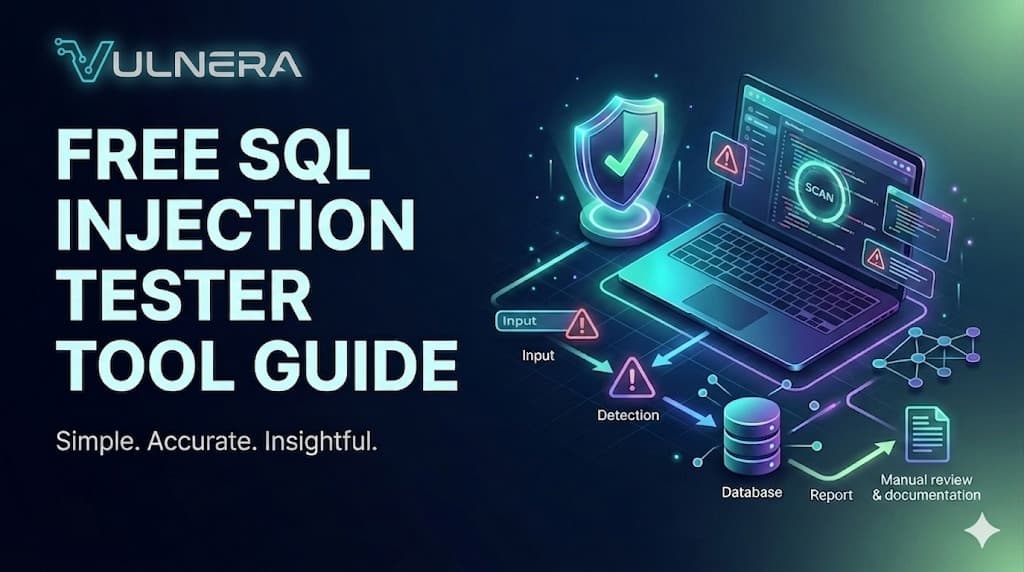
What a useful tester should do
A link-worthy security tool is usually simple. For SQL injection, that means identifying risky inputs, highlighting backend error patterns, mapping suspected database interactions, and helping teams document what needs a manual check. The most useful tools reduce guesswork. They do not replace authorization, scope controls, or remediation guidance.
- Discover query parameters, search forms, filters, and login inputs that reach backend data stores.
- Flag error signatures, inconsistent status codes, and timing differences that suggest unsafe query construction.
- Produce a report a developer can act on, not just a raw vulnerability label.
A safe SQLi testing workflow
Keep testing defensive and authorized. Start by confirming scope, target ownership, and maintenance windows. Then inventory inputs that hit database-backed functionality such as search, sort, filters, profile updates, and admin reporting endpoints.
Next, use automated scanning to reduce the list. This is where Vulnera can help by surfacing obvious injection-prone areas, weak error handling, and suspicious request patterns. After that, a reviewer can validate whether the issue is real, reproducible, and exploitable in the application context.
Keep the final output developer-friendly: affected route, parameter, evidence, risk, and the prepared-statement or ORM fix expected.
Signals worth validating
- Stack traces or verbose SQL errors in responses.
- Different response behavior when a parameter contains unexpected delimiters or malformed values.
- Search and filter endpoints built with string concatenation rather than parameterized queries.
- Legacy admin features, exports, and reports that bypass modern ORM helpers.
How to fix SQL injection
The strongest fix is straightforward: use parameterized queries or a safe ORM path for all untrusted input. Then layer on allow-list validation, least-privilege database accounts, centralized error handling, and logging that records the issue without leaking raw SQL details.
If your team needs a companion reference, pair this page with the Top 50 Common Web Vulnerabilities article so developers can see where SQL injection fits in the broader risk landscape.
Next step with Vulnera
If you want a usable on-site asset right now, this guide functions as the landing page for a free SQL injection testing workflow. The live scan experience on Vulnera can then do the practical work of identifying candidate endpoints and organizing findings into a shareable report.
Check your own attack surface
Use the scanner to identify forms, parameters, and framework behaviors that deserve a manual SQLi validation pass.
Open the Scanner